The history of daily games: from newspaper crosswords to Wordle and beyond
How a 1913 "Word-Cross" puzzle, the Jumble, the sudoku craze and Wordle built the daily-puzzle habit, and where NYT Games, LinkedIn and the -dle boom fit in.
Every morning, millions of people open the same small puzzle that everyone else is solving that day. It feels like a very internet habit, but the idea is more than a century old. The daily puzzle has moved from newsprint to phones without changing much: one puzzle, the same for everyone, and a reason to come back tomorrow.
1913: a "Word-Cross" in the Sunday paper
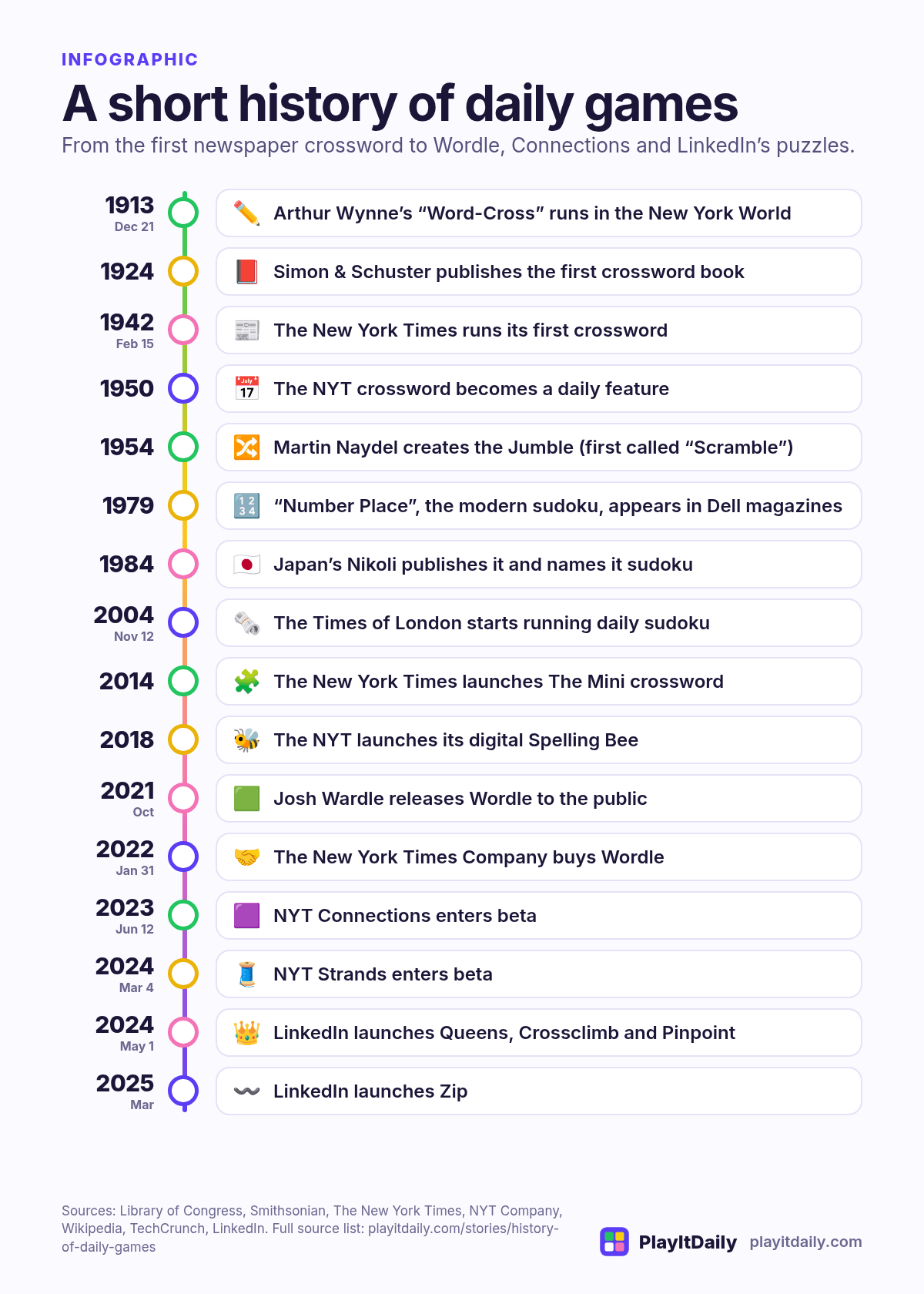
The first crossword is credited to Arthur Wynne, a Liverpool-born journalist who edited the "Fun" supplement of the New York World. His "Word-Cross" puzzle ran on December 21, 1913, in a diamond-shaped grid with no black squares (Library of Congress; Smithsonian). An illustrator later swapped the words by mistake to "Cross-Word", and the name stuck.
Crosswords became a full craze in 1924, when Simon & Schuster published the first crossword book (New York Times timeline). The New York Times held out until February 15, 1942, when it ran its first puzzle in the Sunday magazine, partly as a distraction from war news. Editor Margaret Farrar expanded it to a daily feature in 1950 (NYT). That decision is the root of today’s Mini and the rest of NYT Games.
The funny pages get more puzzles: the Jumble
Newspapers kept adding small daily games. The Jumble, which asks you to unscramble words and then solve a cartoon pun, was created in 1954 by comic artist Martin Naydel under the name "Scramble" (Wikipedia). Like the crossword, it was a daily ritual you could do in a few minutes and talk about later.
The 2005 sudoku craze
Sudoku shows how a puzzle can sit around for decades before it suddenly takes off. The modern form first appeared in 1979 as "Number Place" in Dell puzzle magazines, most likely created by retired architect Howard Garns. Japan’s Nikoli published it in 1984 and gave it the name sudoku. Wayne Gould, a retired Hong Kong judge, came across it in Tokyo, spent years writing a program to generate puzzles, and persuaded The Times of London to run it from November 12, 2004 (Wikipedia). Within months it was everywhere. The New York Times noted in 2005 that its appeal came from rules you could state in one sentence (NYT). You can still play it daily as NYT Sudoku or The Daily SuDoku.
Puzzles go digital: NYT Games
The Times introduced The Mini crossword in 2014, followed by a digital Spelling Bee in 2018, then Letter Boxed, Tiles and others. Its games were played more than 500 million times in 2021, and in December of that year it reached one million Games subscriptions (NYT Company; TODAY).
2021–22: Wordle
Then came Wordle. Josh Wardle, a software engineer in Brooklyn, built it for his partner and released it to the public in October 2021. According to the Times, 90 people played on November 1; nearly two months later, 300,000 did, and soon millions were playing daily (NYT Company). Wardle told TechCrunch that the now-famous emoji grid started with an early player in New Zealand who typed the squares out by hand to share her results; he then built sharing into the game (TechCrunch). Those spoiler-free grids filled social feeds and did most of the marketing.
On January 31, 2022, The New York Times Company bought Wordle for a price "in the low seven figures" and promised it would stay free to play (NYT). By 2024, Wordle was being played 5.3 billion times a year (TODAY).
The -dle boom
Wordle’s format (one puzzle a day, limited guesses, shareable feedback) was easy to adapt, and hundreds of spin-offs followed. Some changed the subject, like Worldle for country outlines or Heardle for song intros. Others changed the scale, like Quordle and Octordle, or swapped words for equations, like Nerdle. Not all of them lasted. Spotify bought Heardle in 2022 and shut it down in May 2023 (TechCrunch), though decade spin-offs like Heardle 80s carry on. Our guide to games like Wordle picks the best of them.
Connections and Strands
The Times kept launching its own games. Connections, where you sort sixteen words into four hidden groups, entered beta on June 12, 2023. By that August it was the paper’s most-played game after Wordle (TechCrunch), and in 2024 players completed it 3.3 billion times (Wikipedia, citing NYT figures). We tell that story in how Connections became a hit. Strands, a themed word search, launched in beta on March 4, 2024 (NYT) and joined the Games app that June (NYT Company). In 2024, NYT Games puzzles were played 11.1 billion times in total (Wikipedia).
Even LinkedIn
The clearest sign that the daily puzzle had gone mainstream came from a professional networking site. On May 1, 2024, LinkedIn launched three once-a-day games: Queens, Crossclimb and Pinpoint (TechCrunch). Tango followed in October 2024 and Zip in March 2025. When it announced Zip, LinkedIn said 84% of people who play one day come back the next (LinkedIn; LinkedIn).
Why the format lasts
From Wynne’s Word-Cross to Zip, the ingredients have hardly changed. Daily games are short, everyone gets the same puzzle, and there is only one a day, so you always have a reason to come back and something to talk about. We look at the psychology in why daily puzzles are so addictive.
Sources
- Library of Congress, "Free Puzzles: Word Cross, Crosswords, and Acrostics"
- Smithsonian Magazine, "How the Crossword Became an American Pastime"
- The New York Times, "75 Years of Crosswords"
- The New York Times, "Birth of the Crossword" (2022)
- Wikipedia, "Jumble"
- Wikipedia, "Sudoku"
- The New York Times, "A Few Words About Sudoku, Which Has None" (2005)
- The New York Times Company, "The New York Times Company acquires Wordle" (Jan 31, 2022)
- The New York Times, "The New York Times Buys Wordle" (Jan 31, 2022)
- TechCrunch, "A conversation with Josh Wardle, creator of viral hit Wordle" (Jan 2022)
- TODAY, "The New York Times Reveals Connections, Wordle Data For 2024"
- Wikipedia, "The New York Times Games"
- TechCrunch, "Connections is The New York Times’ most played game after Wordle" (Aug 2023)
- The New York Times, "How the New York Times Made Its Newest Word Search Game, Strands" (Mar 2024)
- The New York Times Company, "Solvers can now play Strands in the New York Times Games app"
- TechCrunch, "LinkedIn launches gaming: 3 logic puzzles…" (May 1, 2024)
- LinkedIn, "LinkedIn Announces Tango" (Oct 2024)
- LinkedIn, "LinkedIn Announces Zip" (Mar 18, 2025)
- TechCrunch, "Spotify is shutting down Heardle…" (Apr 2023)